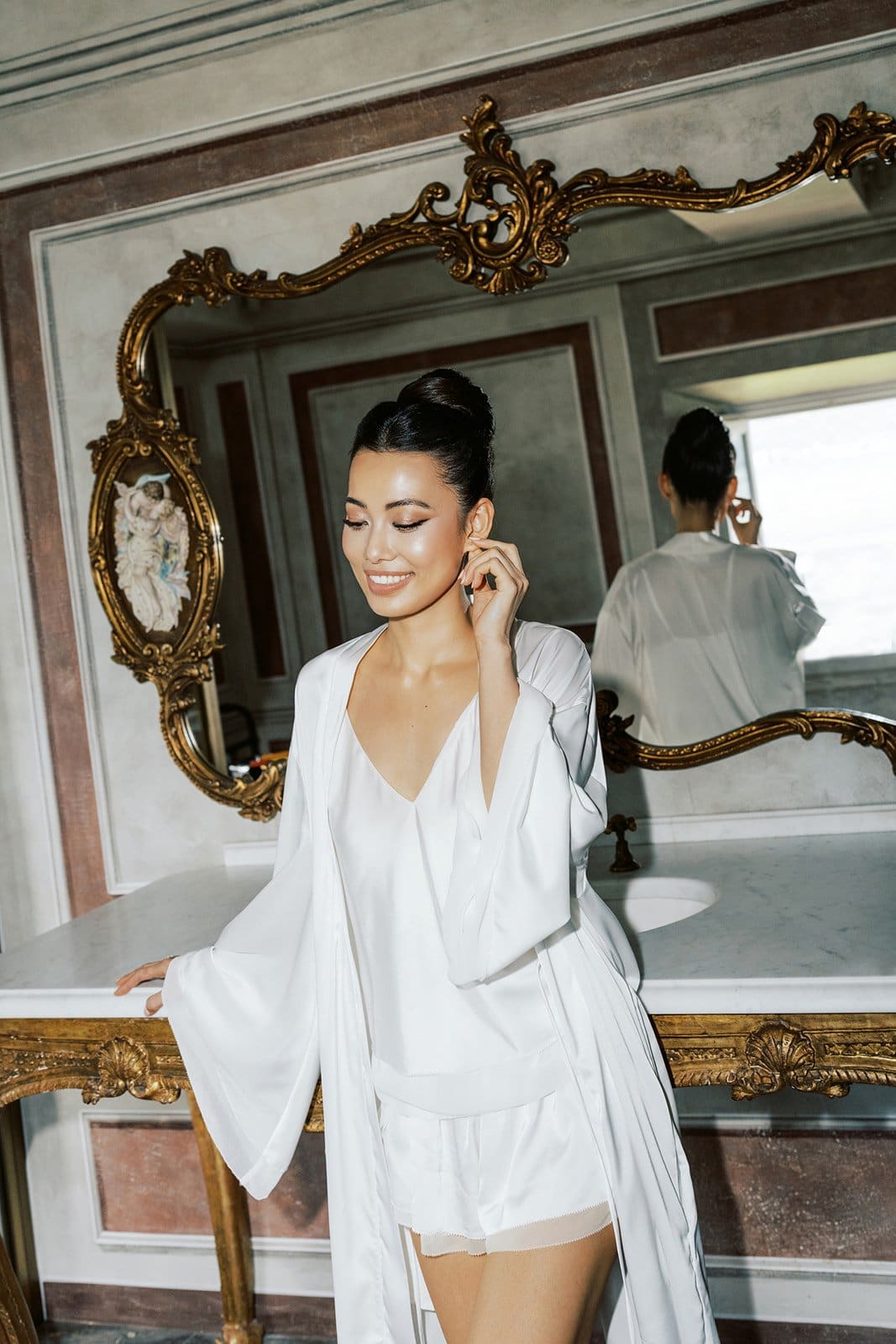


Most guidance on bridesmaid hair and makeup is written for American weddings. It quotes dollars, assumes tipping, and skips the question British Brides actually get stuck on: who pays, and how do you raise it without it being awkward.
Here is the UK version.
Who pays for bridesmaid hair and makeup
There is no fixed British rule, and anyone who tells you there is has borrowed it from somewhere else. Three arrangements are all common and all normal.
The Bride covers everyone. Simplest on the morning, and the most expensive. Worth considering when the bridal party is small, or when you have already asked people to travel and spend on dresses.
Each bridesmaid pays for herself. Also normal. It works best when it is said early, before anyone has bought a dress or booked a hotel, so nobody is surprised by a cost they did not plan for.
A split. The Bride covers hair, the bridesmaids cover makeup. Or the Bride puts a set amount toward each person and anyone who wants more pays the difference. This is the arrangement we see most often and it usually causes the least friction.
The only genuinely wrong approach is leaving it unsaid until the week before.
How to ask your bridesmaids
Bridesmaid hair and makeup is one of those costs that causes friction only when it arrives late. Say it once, early, in writing, and make it easy to decline.
Tell them what you are arranging, what it covers, what it would cost them if anything, and by when you need to know. Give them a clear way to opt out that is not embarrassing. Some bridesmaids would rather do their own makeup, and a bridal party where two people have done their own is not a problem.
One line that works:
I am booking hair and makeup for the morning. I am covering hair for everyone, and makeup is about this much each if you would like it. No pressure at all if you would rather do your own, just let me know by the end of the month so I can confirm numbers.
The wording matters less than the fact that you said it in plenty of time.
How many artists do you actually need
This is the question that decides whether your morning runs calmly, and it is really a timing question rather than a headcount one.
The arithmetic is straightforward:
- Count everyone having hair, and everyone having makeup. Include yourself, your mum, and anyone else joining.
- Multiply each by the time that service takes per person.
- Add your own styling, which takes longer than everyone else’s.
- Work backwards from the time you need to be in your dress, not from the ceremony.
- Divide by the hours you actually have.
Work backwards from being in your dress, not from the ceremony. Photographers usually want you ready before the ceremony time, and getting into a dress is not a five-minute job. If your photographer arrives at midday and the ceremony is at two, your morning ends at midday.
The per-person timings are the one number you should not take from an article. They vary with hair length, the style, whether extensions are going in, and how the artist works. Ask your artist for theirs before you book, and ask for a written running order rather than a finish time. An artist who cannot tell you how long each person takes has not thought about your morning properly.
A worked example, using a bridal party of eight plus the Bride and her mother. That is ten people having two services each, plus your own styling running longer than the rest. One artist working alone cannot do that in a normal wedding morning. Two or three working in parallel can, and the morning stays calm.
There is no fixed number of people per artist, because it depends entirely on the per-person timings and the hours you have. A party of six with a seven o’clock start is a different problem from a party of six with a ten o’clock start, even though the headcount is identical.
So the honest answer to how many artists you need for eight bridesmaids is that you count the services rather than the faces, and the number falls out of the arithmetic.
What a team actually changes
The reason large parties book a team is not speed alone. It is that nobody sits finished and bored for three hours while the light changes and the makeup settles, and nobody is rushed at the end.
Boe styles the Bride personally. For larger parties the Botias Agency team travels with her, so mums, bridesmaids and guests are all taken care of on the same morning without the running order collapsing.
One of Boe’s Brides put it this way: she “kept me calm throughout all the chaos of the day and helping me with getting into my wedding dress”. That is the actual product on a big morning.
Multi-day weddings
Celebrations running over two or three days change the arithmetic rather than the principle.
Each event needs its own running order, and the team needs to know before booking how many mornings they are covering and who is being styled on each one. A welcome dinner where six people want their hair done is a morning in miniature, and it is the one most often left out of the plan.
Mother of the bride, and guests
Both are routinely included, and both are routinely forgotten when the timings are worked out.
If your mum, your partner’s mum, or a couple of guests want their hair or makeup done, add them to the count before you decide how many artists you need. Adding two people at the end of a fully-booked morning is where timings break.
Do you tip hair and makeup artists in the UK
Much of the advice you will find on this says yes, because much of it is American. British tipping habits are different, and they are far less universal than most guides assume.
Which? surveyed 2,134 UK adults in January 2025 and found that nearly four in ten never tip their hairdresser or barber, the closest everyday comparison to a wedding beauty supplier. Its own advice is blunt: you should never feel obliged to leave a tip.
So treat it as entirely optional. If someone has been exceptional, a tip is welcome and never refused. Nobody assumes it, and it is not built into anyone’s pricing here. No artist will think less of you for not leaving one. A review afterwards is worth considerably more to a small business than a tip on the day.
Bridesmaid hair and makeup: what to get agreed in writing
- Exactly how many people are having hair, and how many having makeup
- Who is paying for what, and how it is being collected
- Start time, and the time everyone is finished by
- The per-person timings, as a written running order
- Whether the artists stay for touch-ups, or leave once the party is done
- For multi-day weddings, which events are covered and who is styled at each
- What happens if someone is added or drops out after booking
That last one matters more than it looks. Bridal parties change, and a deposit you have already paid is the part most likely to be disputed later. Which? sets out your rights on wedding deposits and cancellation charges, and the short version is that a business can only keep a deposit or charge you for cancelling in certain circumstances. Knowing that before you sign is worth more than knowing it afterwards.
Botias quotes every wedding individually rather than working from set packages, so the styling, the team and everything agreed comes back as one clear quotation before you book.
Frequently asked questions
Count services rather than people. Eight bridesmaids having both bridesmaid hair and makeup done is sixteen services, plus the Bride’s own styling, which takes longer. Work backwards from the time you need to be in your dress and divide by the hours available. One artist is not enough for a party of that size on a normal wedding morning.
There is no fixed rule. The Bride covering everyone, each bridesmaid paying for herself, and a split are all normal. What matters is saying which one it is early, before anyone has committed to dresses or travel.
No. Some would rather do their own, and a bridal party where two people have done their own looks completely fine in photographs. Make it easy to decline when you first ask.
For a small party with a long morning, sometimes. For a large one, no. The limit is the hours between the first person sitting down and the Bride needing to be in her dress.
Start with the headcount and the finish time, because those decide how many artists you need. Then agree in writing who is having what, who is paying, and whether the team stays for touch-ups.
She usually wants to be, and she is the person most often left out of the timings. Add her to the count before you decide how many artists you need.
It is not expected here in the way it is in the United States. It is always welcome, never assumed. A review afterwards is worth more to a small business.